
The crisis in Europe grew into a global confrontation between the United States and the Soviet Union known as the "Cold War."
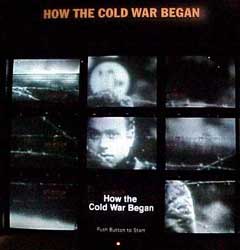
The exhibit includes a 9-screen video wall program highlighting the origins of the Cold War.
A main focus of this area is the Berlin Airlift. There is a timeline that details the crisis in Berlin, from the division of the city at war's end into four zones of occupation to the Soviet blockade in 1948. A map located near the timeline shows the main air corridors into the city with a multi-colored graphic that indicates the amount of supplies shipped to Berlin on a monthly basis.
Above the timeline hang 594 miniature airplanes, the same number used daily in the airlift, with a moving light shining on them, with their shadows giving the illusion that they are flying. A three-minute audio loop provides first-person accounts of the airlift, and visitors will able to hear it by using one of several soundsticks.
Arranged along the walls of the gallery are text panels, photographs, and exhibit cases dealing with The Berlin Airlift, the Truman Doctrine, the Marshall Plan, and the formation of NATO.
In addition, an exhibit titled "Architects of Containment" highlights the roles of George C. Marshall, Dean Acheson, Averell Harriman, and George F. Kennan in the formation of Truman's policy of containment. Directly overhead in the center of the room hang crates, car doors, and supply bags representing shipments of materials within Europe as part of the Marshall Plan.
Below these are two flipbooks. The flipbooks "In His Own Words: Dealing with the Soviets" and "Dissenting Views: Was the Cold War Necessary" provide visitors with insight into and criticism of key Truman-era foreign policy initiatives, such as the Truman Doctrine, Marshall Plan, and the creation of NATO.
Featured documents in this section of the exhibit:
Berlin
- R. H. Hillenkoetter to Harry S. Truman, with attachment, June 9, 1948, outlining possible Soviet reaction to the unification of the French, British, and U. S. administered zones of Berlin. Papers of Harry S. Truman: President's Secretary's Files.
- R. H. Hillenkoetter to Harry S. Truman, June 30, 1948, stating that the Soviets intend to incorporate Berlin into the Soviet-controlled zone of Occupied Germany. Papers of Harry S. Truman: President's Secretary's File.
- Typed diary of Harry S. Truman, January 6-September 14, 1948, covering various issues and events, including decision to remain in Berlin and the 1948 campaign. Papers of Harry S. Truman: Post-Presidential Files.
- State Department Memorandum, n. d. (c. April 1949), regarding the potential for the Soviets to lift their blockade of Berlin. Papers of Harry S. Truman: President's Secretary's Files.
Containment
- President's Daily Appointments, February 18, 1947, listing Truman's scheduled visitors and Truman's handwritten annotation of what they discussed. Papers of Harry S. Truman: President's Secretary's Files.
- Memo from General Frank N. Roberts, June 7, 1946, with attached telegram from George F. Kennan, February 22, 1946, addressing the methods for dealing with the threat from the Soviet Union and why such methods are necessary. Papers of Frank N. Roberts.
Marshall Plan
- Speech draft, "The Requirements of Reconstruction", May 5, 1947, pertaining to the importance of giving material aid to foreign countries and extending the President's ability to control distribution of certain commodities. Papers of Joseph M. Jones.
- Radio and Press Reaction to Secretary Marshall's Harvard Address of June 5, 1947, June 13, 1947, outlining the potential for public support of the Marshall Plan. Papers of Joseph M. Jones.
- Harry S. Truman to Bess Truman, September 30, 1947, expressing concern over situation in Europe and opposition of Congress to aiding Europe. Papers of Harry S. Truman: Family, Business, and Personal Files.
NATO
- Summary of Telegrams, Department of State, February 25, 1949, pertaining to the first discussions of the idea of NATO among the Western European governments. Papers of Harry S. Truman: Naval Aide Files.
- Dean Acheson to Harry S. Truman, Department of State Incoming Telegram, September 15, 1950, addressing some fundamental problems with the development of NATO. Papers of Harry S. Truman: President's Secretary's Files.
- Dwight D. Eisenhower to Harry S. Truman, Februrary 24, 1951, relating to challenges in establishing the command of NATO. Papers of Harry S. Truman: President's Secretary's Files.
Truman Doctrine
- Summary of Telegrams, Department of State, February 25, 1947, pertaining to the need to provide military and financial support to Greece, problems related to Communist control of Poland, and Soviet difficulties. Papers of Harry S. Truman: Naval Aide Files.
- Draft of President's Message to Congress, March 9, 1947, explaining the need for and importance of providing assistance to Greece and Turkey. Papers of George M. Elsey.
- Reading copy of message to Congress, March 12, 1947, explaining the need for and importance of providing assistance to Greece and Turkey and asking for Congressional support. Papers of Harry S. Truman: President's Secretary's File.
- Joseph M. Jones to Loy Henderson, with attachment, February 28, 1947, pertaining to the Communist rebellion in Greece and early discussion of the Truman Doctrine. Papers of Joseph M. Jones.
Truman: In His Own Words
- Diary entry of Harry S. Truman, June 7, 1945, detailing Truman's hope that the United States and U.S.S.R. can reach agreement on postwar issues. Papers of Harry S. Truman: President's Secretary's File.
- Diary entry of Harry S. Truman, July 17, 1945, describing his first meeting with Stalin at Potsdam and expressing optimism in "handling" Stalin, as well as a reference to the atomic bomb. Papers of Harry S. Truman: President's Secretary's File.
- Diary entry of Harry S. Truman, July 26, 1945, containing negative comments about the Soviet Union. Papers of Harry S. Truman: President's Secretary's File.
- Diary entry of Harry S. Truman, July 30, 1945, relating issues left unresolved at Potsdam and negative impressions of the Soviets. Papers of Harry S. Truman: President's Secretary's File.
- Draft letter, Harry S. Truman to Secretary of State James Byrnes, January 5, 1946, chastising Byrnes lack of communication and complaining about Soviet actions since Potsdam, saying he's "tired of babying" them. Papers of Harry S. Truman: President's Secretary's File.